MCP at 97 Million Installs: The Protocol That Became AI's TCP/IP
Anthropic's Model Context Protocol hit 97M installs and joined the Linux Foundation. As a Technical Lead, here's what this means for how we build AI systems today and tomorrow.
Anthropic's Model Context Protocol hit 97M installs and joined the Linux Foundation. As a Technical Lead, here's what this means for how we build AI systems today and tomorrow.
OpenAI's GPT-5.4 crosses the human baseline on OSWorld-V with native computer-use, 1M token context, and parallel tool calling. Here's what it actually means for teams building AI systems in 2026.
Stripe's autonomous agents write 1,300 PRs per week. OpenAI extended its Responses API with shell tools. AWS launched Strands Labs. The agentic shift is no longer theoretical — here's what it looks like in the real world.
The Model Context Protocol crossed 10,000 published servers under the Linux Foundation's Agentic AI Foundation. As someone who's integrated dozens of AI systems, here's why this number matters more than any benchmark.
90% of developers now use AI at work. But the real shift in March 2026 is agents moving from suggestion-mode to autonomous execution. Here's what that actually looks like in production systems and what breaks when you go too far too fast.
Anthropic's Agent Teams feature in Claude Opus 4.6 lets multiple Claude Code instances work in parallel on the same codebase. Here's the architectural model, real-world performance data, and what actually changes for teams building production software.
GPT-5.4 scored 75% on OSWorld-Verified, surpassing human baseline of 72.4%. Here's what this means for developers building agentic systems in 2026, with real API examples and architectural patterns.
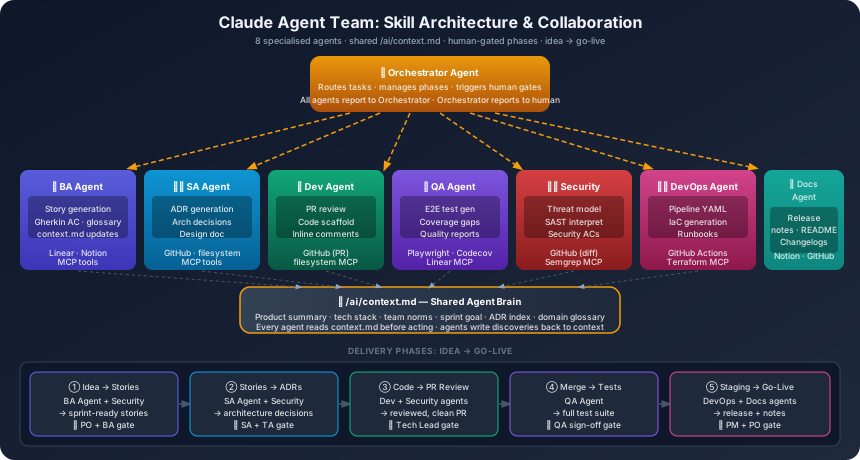
How to build a coordinated Claude agent team: defining agent skills, assigning responsibilities, orchestrating multi-agent workflows, and collaborating across agents to deliver a real software product from idea to production.
Research interviews follow structured protocols with distinct phases. How to build an LLM-driven state machine with next_phase() function calling and dynamic instruction swapping via set_chat_ctx().
Three personas, one infrastructure. How to build an AI interviewer that asks questions, a coach that gives feedback, and an evaluator that scores fairly — all with system prompts, function calling, and state machines.
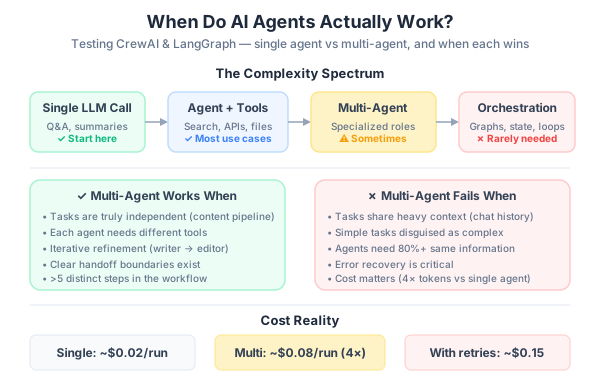
I experimented with CrewAI and LangGraph to build multi-agent workflows. Some were genuinely useful, some were expensive toys. Here's what I learned.
Get notified when I publish new posts on AI, .NET, cloud architecture and more.